Subterranean termite soil barriers establish an engineered, continuous chemical perimeter against Reticulitermes hesperus (Western subterranean termites), which travel from subterranean nests through microscopic…
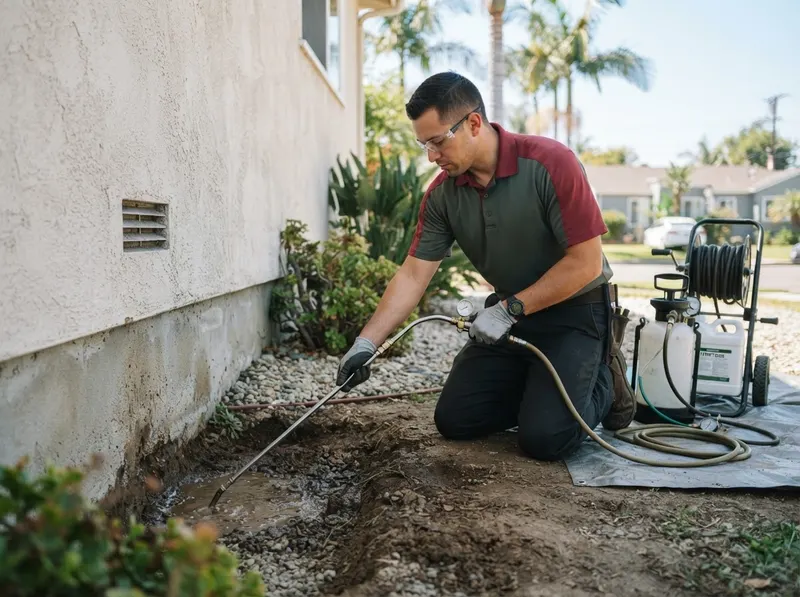
Subterranean termite soil barriers establish an engineered, continuous chemical perimeter against Reticulitermes hesperus (Western subterranean termites), which travel from subterranean nests through microscopic foundation cracks. In flat terrain neighborhoods like Sunkist Park, Culver West, and McManus, moisture migration from high coastal water tables and Ballona Creek creates subterranean nesting pressure directly beneath residential footings. The barrier method requires excavating a continuous trench six inches wide and six inches deep along exterior stem walls, injecting four gallons of non-repellent termiticide per ten linear feet into the backfill, and rodding the soil down to the top of the footing. For attached patios, driveways, and concrete walkways in properties across Carlson Park and Park West, technicians drill half-inch holes spaced twelve inches apart through the concrete, pressure-inject the termiticide into the sub-slab soil, and seal the access points with hydraulic cement.
Selecting a subterranean soil barrier over whole-structure fumigation or standalone exterior bait systems depends on the structural profile of the building. Fumigation addresses drywood termites residing inside wall framing but deposits zero residual defense into the ground, leaving foundations vulnerable to subterranean colonies within 48 hours of tent removal. While surface-level DIY termiticide sprays wash away with irrigation run-off or degrade in topsoil, a professional liquid trench treatment binds tightly to clay and sandy loam soils, resisting microbial degradation and remaining stable for 5 to 8 years. Bait stations require routine subterranean discovery and feeding cycles that can take months to eliminate a mature colony; an injected liquid barrier delivers immediate structural defense by exposing foraging workers to the active ingredient upon contact, which they transfer throughout the underground colony via grooming and food exchange.
Properties located in hillside or clay-heavy areas like Blanco-Culver Crest face distinctive soil expansion cycles that can stress foundational slabs, opening sub-millimeter access channels directly under bathrooms and kitchens. In multi-family complexes and residences near Fox Hills, Studio Village, and Lucerne-Higuera, slab construction limits exterior trenching access, requiring precision interior slab injection along expansion joints and plumbing penetrations. The non-repellent barrier ensures that subterranean termites cannot detect the treated zone, walking through the carrier medium without detour and transferring the active agent to the subterranean queen. This mechanical soil injection method eliminates the need for household relocation or food bagging, maintaining structural defense without vacating the property.
Every job gets a firm, written price after a free on-site visit.
Tell us about your subterranean termite soil barrier job in Culver City and we'll send a clear, written quote, usually the same day.
 PestFence Pest Control